
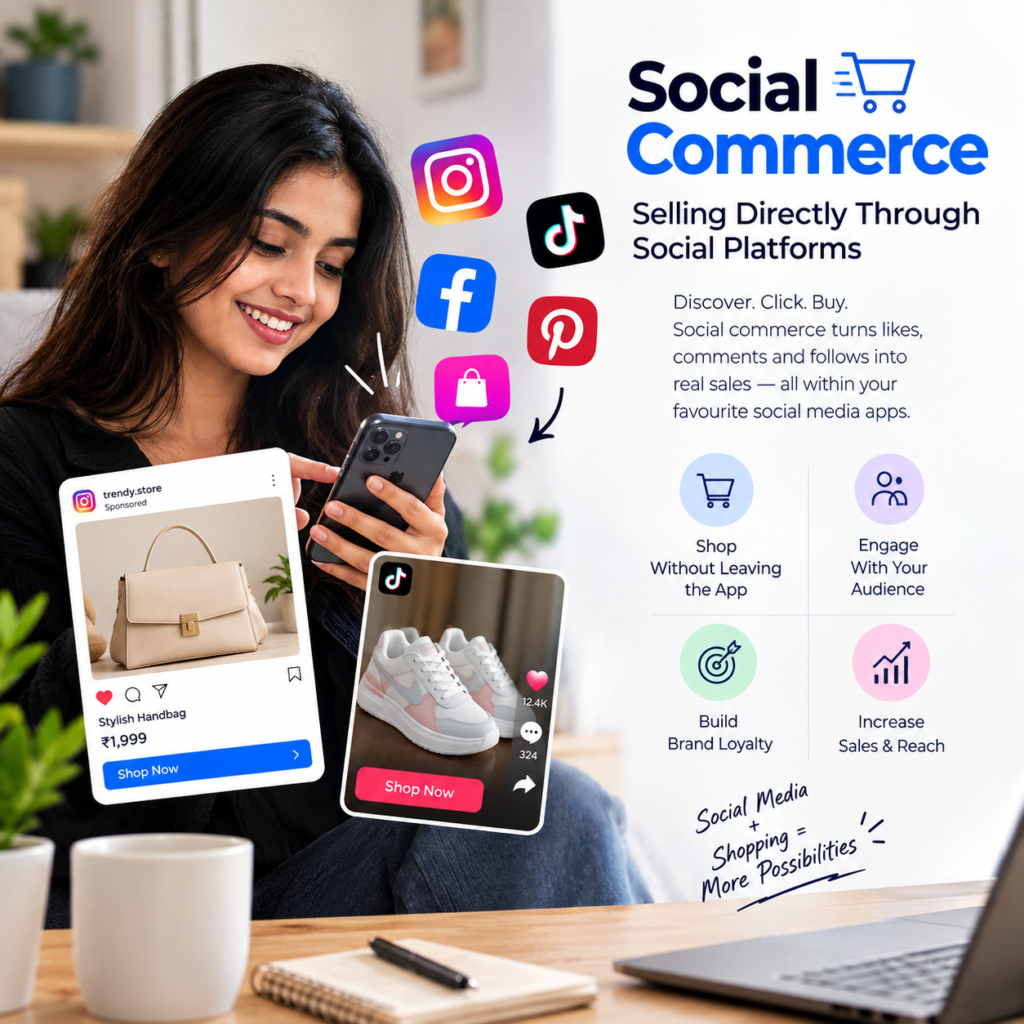
Social Commerce: Selling Directly Through Social Platforms
So what actually changed?
“Shopping on social media” used to mean seeing something cute on Instagram, tapping a link in someone’s bio, and losing interest before the site even loaded. That’s disappearing fast. Analysts peg the global social commerce market at roughly $1.2 trillion by 2027 — and whatever the exact figure, the direction is obvious to anyone who’s opened TikTok lately.Three phrases get treated as synonyms that aren’t: traditional e-commerce is buying on Amazon or a brand’s own site; social media marketing uses Instagram or TikTok as a billboard pointing elsewhere, where the sale actually happens; social commerce is the odd one out — the whole journey, from “ooh, what’s that” to “order confirmed,” never leaves the app.A few things are driving this: patience for extra checkout steps has evaporated, platforms have poured real money into native checkout because it’s genuine revenue for them, and Gen Z never separated social media from shopping in the first place — discovering and buying in the same five seconds is just how it works for them.
Getting the definition straight
Social commerce means the entire purchase happens inside the platform — someone taps a product mid-scroll and pays right there. Social selling, by contrast, is usually B2B: a rep nurturing a lead on LinkedIn over weeks. Social commerce is the colder, transactional cousin — shops, tagged products, a checkout button sitting inside a post.Roughly: shoppable posts in the early 2010s still redirected to a website; Facebook Shops and Instagram Shopping gave brands real in-app storefronts by the mid-2010s; live shopping arrived around 2019–2021, borrowed from China’s massive live commerce scene; and now we’re in the in-app checkout era, where the loop finally closes.
Why this is working so well
Less friction means more sales. Cart abandonment in regular e-commerce sits around 70%, and clunky checkouts are a big reason — shrink it to “tap, confirm, done” and that improves, the same psychology as grabbing a candy bar at a checkout counter. People also trust people more than banner ads: a purchase driven by a friend’s post carries weight a Google ad can’t match, and social commerce puts that recommendation and the buy button in the same spot. Add in the fact that most browsing happens in low-stakes moments — half-watching TV, standing in line — and you’ve got a near-perfect setup for impulse buying.
How the major platforms stack up
Meta Shops (Instagram/Facebook) has the most complete ecosystem — one storefront across both apps, tagged posts and Reels, in-app US checkout. Good for anything that photographs well: fashion, beauty, home goods, food. TikTok Shop is the most dynamic corner of it all, with real-time Live Shopping and a Creator Affiliate Program that lets creators pick up products without a formal deal — it shines for anything worth demonstrating, like beauty or gadgets. Pinterest is an outlier: people arrive with actual discovery intent, and Shoppable Pins plus visual search suit home goods, weddings, and gifts, even if it’s slower. YouTube Shopping leans on video length for higher-consideration purchases like electronics, where a real demo builds confidence. And it all looks different by region — WhatsApp drives serious commerce in India and Brazil, while WeChat, LINE, and Xiaohongshu run ecosystems in China and Southeast Asia that are years ahead of the West.
Actually setting up shop
Get the basics right first: connect your catalog, write descriptions assuming zero context from the buyer, use real high-quality vertical video, get pricing and shipping accurate, verify your account, and read each platform’s policies — a storefront with blurry photos loses people who were ready to buy. User-generated content earns its keep, since a real customer demoing your product beats a polished ad most days; ask for reviews and repost customer content with permission. Live shopping is less intimidating than it sounds — pick the platform your audience uses, promote ahead of time, keep a loose script, offer a time-limited incentive, and treat the chat like a conversation rather than judging everything off one event. You also don’t need celebrities: mid-tier and micro-creators (10K–200K followers) often have more trusting audiences, and letting them find you through an affiliate marketplace beats chasing every partnership yourself. Retargeting rounds it out — catalog ads showing someone the exact product they browsed are some of the most efficient dollars you’ll spend.
What content actually converts
Short, honest demos beat polished commercials — thirty to sixty seconds of what the thing does and what problem it solves. Behind-the-scenes and unboxing content builds trust by making a brand feel like real people, and visible social proof — genuine comments, reposted reviews — quietly does a lot of persuading too. Calls to action should match platform behavior (“tap the bag icon” on TikTok, “tap to shop” on Pinterest); spell it out rather than assuming anyone knows what to do.
The parts nobody loves talking about
Fees and payout timing can bite you — TikTok Shop’s selling fee varies by category, and payouts aren’t instant, so build fees into pricing and know the schedule up front. Analytics are thinner than running your own site, so supplement platform dashboards with UTM parameters and your own tracking. Customer service gets messy fast when buyers expect support inside the app — set up a clear path (email, bio link) from day one and answer public complaints quickly. And trust is harder to build without a “real” website feel, so keep policies visible and reviews front and center.
What to actually watch
Conversion rate matters most — of the people who tap a product, how many buy? Cart abandonment flags friction, engagement-to-purchase shows whether attention is converting, and revenue per post tells you which content earns its keep. Start with native dashboards, layer in Google Analytics via UTMs, and remember likes and views aren’t revenue: 2,000 views and 40 purchases beats 50,000 views and none.
A quick example worth thinking about
A small skincare brand with mediocre Instagram ad returns listed products on TikTok Shop and opened an affiliate program without reaching out to anyone directly. Within weeks, mid-size creators found the products organically, and one unscripted 45-second video from an 80,000-follower creator moved a few hundred units in a weekend. What worked: letting creators speak in their own voice, pricing commissions attractively, answering every comment fast, and feeding back whatever performed best into future content. Not every category will replicate this exactly, but the underlying idea — remove friction, let real people talk about the product — tends to hold up.
Where this leaves you
Social commerce isn’t something to watch from a distance anymore. The numbers, Gen Z’s habits, and the platforms’ own investment all point the same direction. None of it requires a huge budget to start: pick one platform, get the shop fully set up, and publish two or three shoppable pieces of content a week for a month. Get one channel working before spreading thin — the brands building this habit now will have a real head start once social commerce stops being the alternative and just becomes how people shop.