
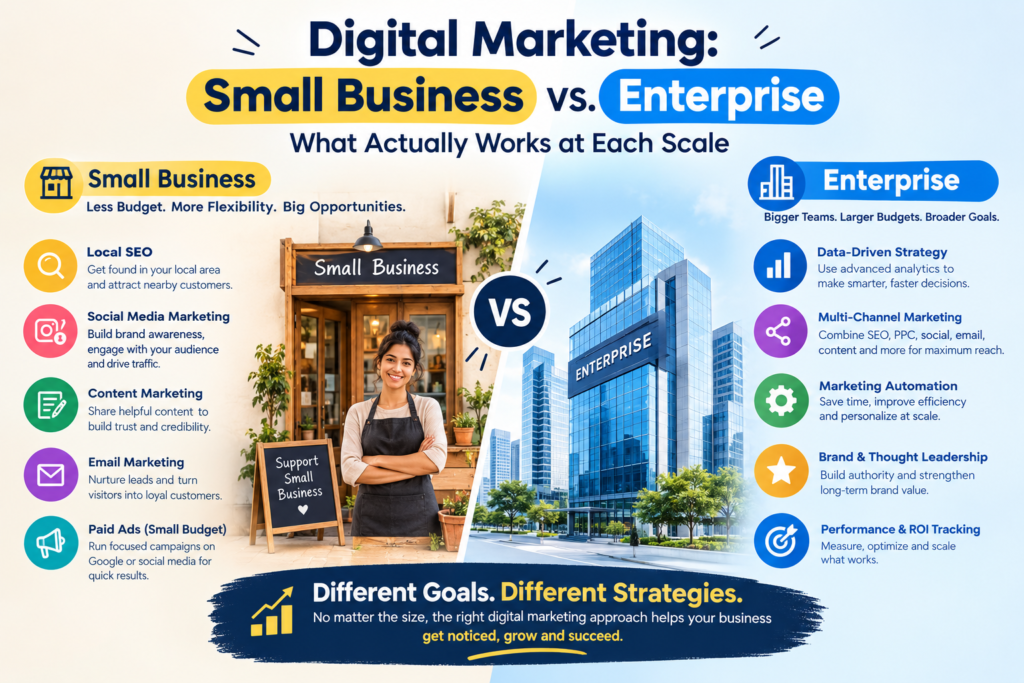
Digital Marketing: Small Business vs. Enterprise — What Actually Works at Each Scale
A friend of mine runs a candle business out of her garage. A few months ago she messaged me, frustrated, asking why her Instagram strategy “wasn’t working like Nike’s.” She’d posted consistently, followed all the best practices she’d read online, and still felt like she was shouting into the void while brands with huge followings made it look effortless.Here’s what I told her: she wasn’t supposed to be doing what Nike does. Not because her business is smaller or less important — but because they’re playing two completely different games.Every business technically “does digital marketing.” But look closely and the similarities stop there. A five-person startup can change its entire content strategy over a Slack message during lunch. A Fortune 500 company might need three departments, a legal review, and two rounds of approvals just to tweak the wording on one ad. Neither approach is wrong — they’re built for different realities.This isn’t about which one “wins.” It’s about knowing which game you’re actually playing.
The Real Differences (Not Just Budget)
Everyone assumes it comes down to money. It’s part of it, sure — but the bigger differences are things nobody really tells you until you’re in the room:Small teams don’t have the luxury of spending a week on one campaign — time is as scarce as money. One person is often wearing five hats, while an enterprise has entire departments that have never even met each other. A small business owner can change strategy over lunch; an enterprise needs a meeting about the meeting. Small businesses start with zero trust and have to earn it fast; enterprises start with built-in trust but risk it feeling hollow if they’re not careful. One side runs on a handful of simple tools, the other on a tech stack that needs its own onboarding manual. And one bad campaign can sting a small business for months, while an enterprise barely notices.
How Small Businesses Actually Win
This isn’t about settling for less — it’s about punching above your weight.
Go where the ROI actually is. Local SEO and a genuinely optimized Google Business Profile are boring and unglamorous, but they work. Organic social that feels like a person posting, not a brand account managing optics. And email — unsexy, but it’s the one channel you actually own.
Let people see the human behind it. A founder showing up on camera beats a polished ad nine times out of ten. Niche blog content that answers the weirdly specific questions big brands won’t bother touching builds trust fast.
Move fast — that’s the real superpower. Jump on a trend the same day it happens, not three approval cycles later. Test twenty dollars on an ad before betting the month’s budget on it.Where it usually goes wrong: trying to be everywhere at once and doing none of it well, or flying blind because nobody’s actually checking the numbers.
How Enterprises Actually Win
If small businesses play checkers, enterprises play chess — different game, not a better one.
Built for scale, not speed. Automation platforms like HubSpot, Marketo, and Salesforce do the heavy lifting across thousands of touchpoints. Campaigns run in sync across ten channels at once, something no five-person team could pull off manually.
Decisions backed by mountains of data. Attribution modeling traces a single sale back through a dozen touchpoints. AI personalization adjusts the experience for millions of people individually, not just in bulk segments.
Staying “on brand” across the whole map. Running campaigns across countries and languages without losing the core identity is its own skill — balancing strict brand guidelines against letting local teams actually connect with their market.
Where it usually goes wrong: by the time a trend clears legal and approvals, it’s already dead. And sometimes everything is so polished it stops feeling like it’s talking to an actual human.
Where They're Not So Different After All
Here’s the part that ties it together. Both are lost without knowing exactly who they’re talking to. Both live and die by content — just at wildly different volumes. Both are scrambling to adapt now that cookies are disappearing and first-party data is king. And both are leaning on AI — one’s using it to draft Instagram captions, the other’s built custom models around it.
A Simple Way to Figure Out Your Own Move
Instead of overthinking it, ask yourself three questions:
What can I actually afford to spend per channel — not in theory, but this month? Do I need people to know me right now, or do I need them to buy right now? And what am I willing to hand off to automation, versus what still needs a human touch?
(A quick channel-by-channel matrix — SEO, paid ads, social, email, influencer — showing small business vs. enterprise priorities would work well visually here.)
Real Examples, Not Hypotheticals
Think of a small DTC brand that blew up purely through organic TikTok hustle — no ad budget, just consistency and a founder willing to show their face. Now think of a major retailer running AI-driven personalization at a scale where no two customers see quite the same homepage. Same goal — get noticed, get trusted, get bought from — completely different paths to get there.
Wrap It Up Like a Conversation
Don’t copy someone else’s playbook — build the one that actually fits your size. Small businesses win by being real and fast. Enterprises win by scale and precision.
So — which one are you? A scrappy five-person team figuring it out as you go, or navigating a much bigger machine? Either way, the strategy has to fit the size of the ship you’re steering.